
Modern Foreign Languages
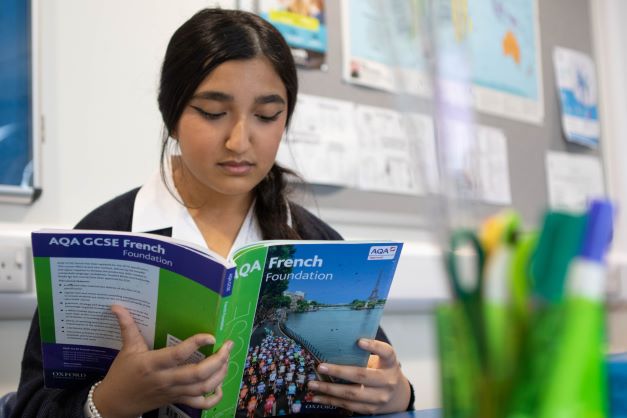
Subject Leader - Ms Simonin
Learning a foreign language opens the door to other cultures and frees pupils from linguistic insularity. Our curriculum aims to nurture curiosity and deepen pupils’ understanding of the wider world. We want students to express ideas confidently in another language, understand and respond to its speakers in both speech and writing, and communicate for practical purposes. Through this, they develop new ways of thinking and gain the skills needed to study or work abroad.
By the end of KS3, pupils build on the foundations established in KS2 to develop secure competence in listening, speaking, reading and writing. They acquire core grammar and vocabulary that enable them to understand and convey personal and factual information, meet their immediate needs and interests, and begin to justify opinions with increasing spontaneity, independence and accuracy.
By the end of KS4, pupils should be able to communicate confidently and coherently with native speakers, both orally and in writing. They will have broadened their horizons, explored cultures beyond their own, and developed new perspectives on the world.
French and Spanish are taught as Modern Foreign Languages in Years 7 and 8. At the end of Year 8, pupils may choose to continue with French, Spanish, or both as GCSE subjects.
Key Stage 3 Content
Year 7
-
French – Introduction to the French world, talking about me, celebrations in French speaking countries, talking about family, describing people and using opinions, talking about school as well as sports and activities.
-
Spanish – Introduction to Spanish world, my life, descriptions and opinions, free time and school.
Year 8
-
French – Talking about holidays, talking about festivals and celebrations, talking about leisure and activities
-
Spanish – Holidays, free time activities, festivals and celebrations, leisure and activities
Homework
Students receive weekly homework linked to the vocabulary, grammar and verb conjugations introduced in class. We start the learning together, but practising at home is vital for pupils to consolidate their knowledge and retain it over time.
Assessment
Assessment takes place routinely, both formally and informally. Formal assessment includes regular learning of vocabulary, grammar rules and verb conjugations. Informal assessment happens continuously during lessons through questioning, practice activities and teacher observation.
All four language skills - speaking, listening, reading and writing—are assessed to monitor pupils’ understanding of the topics taught. Feedback is provided at every stage so that pupils can reflect on their progress and know exactly how to improve.
How Parents and Carers Can Support
-
Ask your child to explain how verbs change to express the past, present and future—this helps reinforce their understanding.
-
Support your child in being curious about the wider world. This might include reading newspapers, watching news programmes or exploring stories connected to French‑ or Spanish‑speaking countries.
-
Help your child review their weekly vocabulary, grammar rules and verb conjugations.
-
Encourage your child to make use of public libraries and online resources where available.
Additional Support Available/Useful Links
-
www.bbc.co.uk (BBC Bitesize)
-
www.studyspanish.com (for Spanish)
-
www.studyfrench.com (for French)
Reading List
-
French or Spanish newspapers (available locally or online.)
-
www.yahoo.fr
-
Asterix books in French or Spanish
Key Stage 4
Exam Board and syllabus code
-
AQA 8652(French) GCSE French 8652 | Specification | AQA
-
AQA 8692 (Spanish) GCSE Spanish 8692 | Specification | AQA
Content
At Key Stage 4, French and Spanish become optional subjects. Pupils who have built strong foundations at Key Stage 3 are encouraged to continue their language learning into Years 9, 10 and 11. Studying a GCSE in a Modern Foreign Language not only strengthens pupils’ academic profile but also supports future pathways, as many universities and competitive courses value a GCSE in a language.
Beyond qualifications, GCSE Languages develop highly transferable skills such as confident communication, cultural awareness, problem‑solving and effective presentation – all of which are increasingly sought after in higher education and the workplace.
Students study the following themes on which all four GCSE papers (Speaking, Writing, Reading and Listening) are based:
Theme 1: People and lifestyle
It covers the following three topics:
-
Topic 1: Identity and relationships with others
-
Topic 2: Healthy living and lifestyle
-
Topic 3: Education and work
Theme 2: Popular culture
It covers the following three topics:
-
Topic 1: Free-time activities
-
Topic 2: Customs, festivals and celebrations
-
Topic 3: Celebrity culture
Theme 3: Communication and the world around us
It covers the following three topics:
-
Topic 1: Travel and tourism, including places of interest
-
Topic 2: Media and technology
-
Topic 3: The environment and where people live
Alongside learning key vocabulary for each GCSE theme, pupils continue to build on the grammatical knowledge established at Key Stage 3. They are taught the essential rules of grammar so they can communicate accurately and confidently in both spoken and written French and Spanish. In lessons, pupils are encouraged to use as much of the target language as possible to strengthen fluency and spontaneity.
While all pupils work towards producing high‑quality, grammatically accurate work, it is important to remember that effective communication remains central to success across the GCSE assessments.
Assessment
GCSE French and Spanish are assessed entirely by final examinations at the end of Year 11; there is no coursework or controlled assessment.
Throughout the course, pupils are assessed regularly. This includes formal checks such as weekly vocabulary, grammar and verb‑conjugation learning, as well as ongoing informal assessment during lessons. All four language skills—listening, speaking, reading and writing—are monitored, with frequent feedback provided so pupils can reflect on their progress and understand how to improve.
Twice a year, pupils complete full mock examinations in all four skills. These assessments help measure their understanding of the topics taught and prepare them for the demands of the final GCSE exams.
At Key Stage 4, pupils are examined in the four skill areas: Listening, Speaking, Reading and Writing. Each skill accounts for 25% of the final grade. There are two tiers of entry—Foundation and Higher. Foundation Tier awards grades 1–5, while Higher Tier awards grades 4–9. Pupils must sit all four exams at the same tier.
Homework
In addition to weekly vocabulary, grammar, conjugation learning and testing, pupils complete written tasks designed to reinforce the grammatical structures taught in lessons. These activities help strengthen their ability to produce well‑structured French and Spanish across all four skills.
Pupils also build a personal portfolio of questions and answers for each GCSE topic. This forms an essential foundation for the speaking and writing examination they will complete in Year 11.
How Parents and Carers Can Support
-
Encourage your child to log into Kerboodle each week to review class content. They can access both Foundation and Higher textbooks, along with topic‑specific resources and interactive practice activities.
-
Ask your child to explain how they would conjugate a verb from the current topic in the past, present and future. This helps reinforce their understanding of key grammar.
-
Provide your child with a good dictionary, online dictionary to support accurate completion of homework and classwork, and to help them broaden their vocabulary. Please note that dictionaries are not permitted in GCSE examinations.
-
CGP publishes revision and practice guides for both French and Spanish. These are available to pupils in Years 10 and 11 and can be a valuable support at home.
Additional Support Available/Useful Links
Websites
-
For full details of the GCSE syllabus, examinations and exemplar materials, visit the AQA Languages page: www.aqa.org.uk/languages
-
Kerboodle: Pupils can access digital textbooks and resources using their individual login details.
-
For online practice in Listening and Reading, as well as links to French and Spanish language sites:
-
BBC Bitesize French – www.bbc.co.uk/schools/gcsebitesize/french
-
BBC Bitesize Spanish – www.bbc.co.uk/schools/gcsebitesize/spanish
Additional practice and grammar support: